Harmonics and Notches in Dynamic Test Load

Active Harmonic Filters Improve Dynamic Test-Bed

A major pioneer in the manufacturing industry caused problems on the power supply network with their dynamic test bed. Here, an installation of the right combination of active harmonic filters now compensates harmonics up to the 100th order with great results. Both harmonics and voltage notches are reduced to enable top performance of the equipment.

Case Background
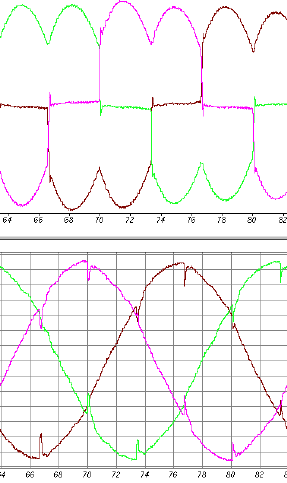
Dynamic test load before harmonics compensation

Before Compensation:
– Very high distortion on current
– Note the severe voltage notches

The test benches, owned by the development department of a major European production plant, are used to test components in the development phase. Varying test conditions can be programmed, which gives the test bench very dynamic properties.

Harmonics Compensation Challenge

The same transformer is connected to two parts of the test bench. With a very dynamic load whose load current amplitude can change from zero to maximum in approximately 100 ms, it was impossible to run both parts of the test bench simultaneously. The voltage notches of up to 25% in combination with very high harmonic disturbances prevented this. This caused serious delay in the testing facility as well as exceeding the limits in EN61000-2-4.

Active Harmonic Filters – the Solution

To solve the power quality issues, several active harmonic filters were installed to compensate the disturbances. Two 200/480V filters were installed together with one 100/480V filter that in combination compensate all frequencies up to the 100th harmonic order. The first two filters can be used to compensate lower harmonics while the third compensates for higher order harmonics and interharmonics. The three units were configured to share the

load with the 100/480V filter working on higher orders only. This resulted in extremely short response times and considerably lowered load disturbances.

Dynamic load after harmonics compensation

After Compensation:
– Very low distortion on both voltage and current
– Note the reduced notches

Harmonics Compensation – the Result

Thanks to the active harmonic filter installation, voltage notches could be reduced to 10%. In addition, harmonics were lowered to the required level stipulated in EN61000-2-4. Now, both test benches can be run simultaneously without any of the problems caused by poor power quality.

STATCOM Case Study

STATCOM AHF Reduces Flicker

Due to an increased usage of the local grid, a stricter limit of flicker emission became a necessity. One of the largest steel wire producers in Europe managed the problem by installing a STATCOM solution and lowering their flicker emissions.

Background

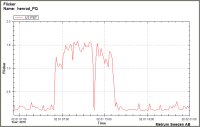
Flicker before statcom compensation

Flicker Before STATCOM Compensation

The processing plant is the largest steel wire producer in Europe, part of a German industry group founded in 1856. The company produces steel reinforcement mesh grids. The production line is made up of various welding equipment, including spot welders from Schlatter AG. As is the case with all powerful spot welders, the abrupt current consumption causes voltage variations, which in turn produces flicker.

Challenge

Due to expansion of the area and increased amount of renewable energy sources, it became necessary to lower flicker contribution. Early reference measurements showed flicker levels up to Pst 2 and Plt 1.4. A futher

Flicker after STATCOM compensation

Flicker after STATCOM compensation

complication the the case was caused by a lot of switching activity in the surrounding electrical grid. This contributed to higher background flicker and making measurements more difficult. Finally, depending on the production type currently running, the flicker will vary.

STATCOM by AHF – the Solution

The solution was offered in cooperation with Schlatter AG, who also delivered the welding lines.
A STATCOM solution consisting of 7 300/690W water cooled active harmonic filters was installed. The nominal installed power is 2.5 MVAr. The fully water cooled STATCOM follows the load dynamically. Neither changes in the production nor newly installed equipment leads to any need for adjustment of the compensation system. The AHF units were installed via a dedicated transformer and use their own medium voltage measurement point.

Delivered Results

The STATCOM solution reduced the flicker level to Plt 0.6. Reduced reactive power lowered current consumption 25-40%. Voltage dips on the 20 kV rail were lowered from around 500V to around 100V.

Flicker Compensation Case Study

  AHF Flicker compensation welding

AHF Reduces Flicker from Radiator Production

Today’s industry constantly faces new challenges. As the local community grows, large businesses with energy intensive production processes are faced with the challenge of reducing their effects on the grid. High flicker emission levels can potentially disturb other industries on the public grid.

Background

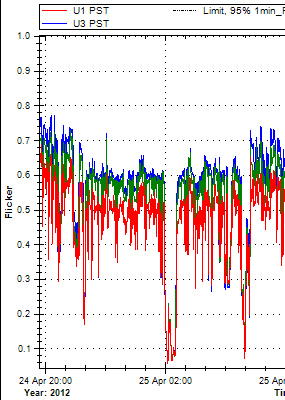
Flicker levels before AHF compensation

Flicker Level Before Compensation

The plant is a 55000 square meter radiator factory in Belgium, It consists of six production lines that in total can produce about 5000 radiators a day. The production process consists of presses, seam welding and spot welding. The process is inherently very energy demanding and so puts great demands on the power grid. These processes combined to create large voltage drops in the feeding substation with the result of too high Pst values. The problems at the plant caused flashing lights when the local utility company would connect other consumers to the same transformer.

Flicker level after AHF compensation

Flicker Level After Compensation

Challenge

The local utility company demanded that the Pst 95% value could not exceed 0,7. Measured values during 2009 showed tops in the Pst equivalent to 1,6. Achieving this goal was no small feat due to the rapidly fluctuating load, and the many different load patterns that could occur with such a high number of welding machines.

Active Harmonic Filters – the Solution

The market leading response time for the active harmonic filter was a necessity for the customer to reach the values that the utility company demanded. The system consists of six units, making it a total of 2,1 MVAr continous power to compensate for the voltage drops.

Installation of Active Harmonic Filters Creates Results

After installing the active harmonic filters, the plant has managed to keep their Pst value below 0,63, regardless of how many welding lines are run simultaneously. The reference values have been measured by external consultants and approved by the local utility. As a side effect of the lowered flicker value, the plant now also enjoys stabilized production environment.

Harmonics Mitigation on VFD – Case Study

Harmonics mitigation of variable frequency drives

Harmonics Mitigation Increases Output with 30%

The water treatment process involves a large number of variable-speed pumps to process large amounts of fluids. By using Active Harmonic Filtering technology to optimize the electrical behaviour of their variable frequency drives, a major water processing plant in Sweden managed to increase the maximum output capacity of their systems by 30%.

Thanks to Active Harmonic Filtering we can now process 30% more fluids during periods of peak demand. We also save energy.
– Project Manager

Background

The treatment plant is part of the sewage works in Gothenburg. It is one of the largest in all of Scandinavia and central to saving the environment from pollution. With heavy demands, the two basic requirements on this critical regional infrastructure are constant operation and sufficient treatment capacity. UPS power backup systems are crucial to ensure a secure and stable power supply.

Harmonics mitigation

To increase plant capacity, 17 new VFD-controlled pumps were installed at the processing plant. This increased harmonic distortion on the electrical system significantly and the resulting overcurrents caused the UPS fuses to melt. To avoid this, the pumps were run at reduced speed. This was however a temporary solution as it reduced treatment capacity below demand. Frequency converters are a well-known source of potentially damaging harmonics.

Harmonics Elimination – the Challenge

After consulting a premier Swedish consulting firm, the processing plant announced a public procurement process seeking the implementation of active harmonic elimination technology. The target was to retrieve full treatment capacity by eliminating the harmonics.

Solution – Active Filter Units

The result was the installation of two 600 kVA Active Harmonic Filter units to manage two transformers supplying 2160 kVA. There were a number of characteristics of the specific harmonic filter solution that led to the plant’s choice:

  • Flexible connection and system dimensioning
  • Reduced maintenance costs to other connected equipment
  • Disturbance free electrical environment
  • Reduced energy consumption through decreased transformer losses

Harmonics Eliminated – the Result

Eliminating the harmonics in the system resulted in an increased max output capacity of 30%.
In addition, the processing plant now manages to operate below the threshold value for harmonic distortion (SS 421 1811). The plant now enjoys further benefits with a reduced energy consumption and improved environmental performance.

Harmonics Case Study

food processing harmonics

Harmonics Case Study:
Secure Food Production by Mitigating Harmonics

Highly automized processes often contain VFDs, which cause harmonics in the power supply. This can affect machinery and can cause downtime in production lines. This was the case at a major food processing plant in Dortmund, Germany.

Background

Harmonics profile before AHF

Before:
High harmonic current distortion
Large disturbance of production

The food processing plant is part of a federation of over 300 independent retail dealers and suppliers to approximately 540 grocery stores. The center is a 100.000 m² warehouse and distribution center with affiliated butcher. After the butcher was destroyed in a fire in 2009, it had been rebuilt and expanded in 2011 into an 18.000 m² large butcher shop. Since completion at the end of 2011, the new processing plant produces 250 tons of meat for the grocery stores and up to 25 tons of sausages every day. The new butcher shop contains state of the art logistics and meat processing systems.

Challenge

The VFDs connected to the new meat cutter created typical current harmonics of a six-pulse-converter (5th, 7th, 11th, 13th, etc). These harmonics resulted in commutation notches in the voltage, which influenced the whole production process. The harmonics caused blackouts and disturbances to the lighting. It also influenced the sausage stuffing and caused long production stops disturbing the process flow. Occasionally up to half of the employees had to be sent home for the day due to disturbances in the process.

Harmonics profile after AHF

After:
Low harmonic current distortion
No disturbance of production

Solution – Active Harmonic Filter with Harmonics Compensation

The food processing plant decided to use an Active Harmonic Filter to eliminate the problems in the power supply. The installed system consists of one filter with a capacity of 300 A harmonics compensation to provide the needed harmonic power for the meat cutter.

Result

After the installation and a short commissioning, all disturbing harmonics were cancelled and the commutation notches disappeared. All meat cutters could now, for the first time, be started at the same time, without any effect on lighting or the sausage stuffing process.

Trusted Suppliers

Train in tunnel

Trusted suppliers of Active Harmonic Filters

There are plenty of suppliers of Active Harmonic Filters on the market. Their capabilities vary and the innovations within the field have been numerous. While some filters really only compensate for harmonics, other Active Harmonic Filters have the ability to compensate for just about any power quality problems with a few software adjustments to fit your specific problem profile.

Investing in Active Harmonic Filters

Make sure to always start by getting proper measurements to ensure you know what issues are the real cause of your power quality problems. Harmonics is only one of many potential concerns with regards to power quality – transients, oscillations and flicker are just a few of the additional problems you could be facing.

There are many potential solutions within the power quality field. Keeping an open mind is the best way to ensure you get the most effective solution and best ROI on your investment. It may also be that a combination of technologies is the most effective way to protect your production.

Trusted Suppliers of Active Harmonic Filters