
Tagged: Power quality
Harmonics – What They Are
What is Harmonics

Sine Harmonics (Image Wikipedia)
Simply put: Harmonics are unwanted frequency components and unbalance in terms of uneven power distribution between the phases in the electrical network.
More exactly: Harmonics are disturbances to the sinusoidal voltage waveform. They are multiples of the supply frequency, in other words if the supply frequency is 50 Hz the fifth harmonic would be 250 Hz. These variations from the pure sine form are caused by non-linear loads from electrical machinery and appliances. These non-linear loads can be caused by anything from battery chargers to variable speed drives or flourescent lighting. High levels of harmonics can cause power quality problems and voltage distortions.
Harmonics and the power quality problems they cause can have expensive and often detrimental effects on machinery and appliances. Flourescent lighting may need to be changed continuously, electric motors may have a higher frequency of break downs and a shortened life span. Some common direct impacts of poor power quality in the shape of harmonics are:
- Lower production speed
- Increased energy consumption
- Charges for reactive power consumption
- Damaged equipment
- Premature equipment aging
- Data loss
The fact is that harmonics have become a problem for many business sectors and the costs are consistently rising. The number of disturbances are increasing and modern production equipment is becoming more sensitive to these disturbances.
Harmonic Distortion Standards
Harmonics caused by large machine parks can also have an effect the grid. This is why there has been an increase in regulations and standards required by municipals. Some examples of standards governing harmonics emissions are IEEE 519, G5/4, EN 61000, EN 50160, D-A-CH-CZ, among others. Some standards are also specific to certain applications, such as DNV or ABS for offshore applications. The standards most commonly require a voltage harmonic distortion below 5-8%.
Active Harmonic Filters In Printing Applications
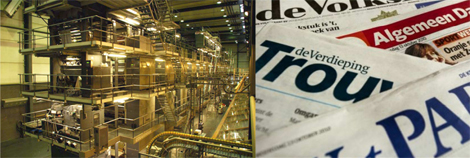
Harmonic Filter Restores Power Quality and Reduces Downtime Caused by Harmonics
Problems with power quality often become apparent through problems in production and surrounding equipment such as lighting.
This is what happened at one of the largest printers in Holland.
Background
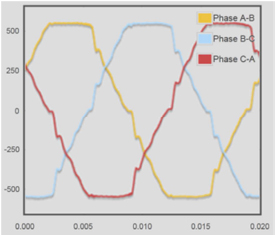
Line to line voltage without Active Harmonic Filter
The printing company consists of two printing plants located in Amsterdam. The plant employs 170 people, producing six daily newspapers and several other free local papers and magazines. The plant prints up to 1 million papers every day with printing presses running almost nonstop.
Poor Power Quality – the Challenge
The printers had been struggling with power quality problems for many years. Flourescent lighting had to be changed continuously as the tubes kept failing. The electrical ballast had to be changed every six months instead of every 5 years. This kept one employee busy 2-3 days a week. In 2011 just the lighting problems and other broken components cost the printers about
300 000 €. In addition to these losses, the plant had power quality related problems during startup of the presses, which resulted in additional losses through production downtime.
Active Harmonic Filters – the Solution
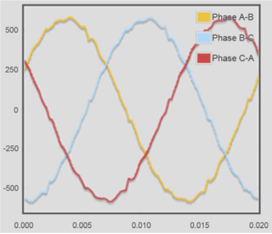
Line to line voltage with Active Harmonic Filter
The printing group decided on an investment in power quality and quite literally, a brighter future. Six harmonic filters with a total compensation current of 1800 A were installed to optimize the power grid and reduce harmonics.
Harmonic Filtering Gave Quick Results
Following installation and commisioning of the active harmonic filters all previous problems disappeared. The printing plant can nowuse their printing presses without disturbances from poor power quality. Due to the continuous stops in production and equipment failure, which had been a daily occurrance, the return on investment for the harmonic filtering system was very short.
Harmonics and Notches in Dynamic Test Load
Active Harmonic Filters Improve Dynamic Test-Bed
A major pioneer in the manufacturing industry caused problems on the power supply network with their dynamic test bed. Here, an installation of the right combination of active harmonic filters now compensates harmonics up to the 100th order with great results. Both harmonics and voltage notches are reduced to enable top performance of the equipment.
Case Background
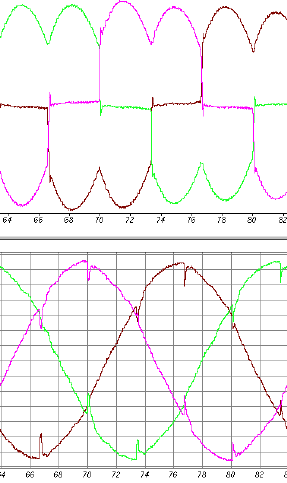
Before Compensation:
– Very high distortion on current
– Note the severe voltage notches
The test benches, owned by the development department of a major European production plant, are used to test components in the development phase. Varying test conditions can be programmed, which gives the test bench very dynamic properties.
Harmonics Compensation Challenge
The same transformer is connected to two parts of the test bench. With a very dynamic load whose load current amplitude can change from zero to maximum in approximately 100 ms, it was impossible to run both parts of the test bench simultaneously. The voltage notches of up to 25% in combination with very high harmonic disturbances prevented this. This caused serious delay in the testing facility as well as exceeding the limits in EN61000-2-4.
Active Harmonic Filters – the Solution
To solve the power quality issues, several active harmonic filters were installed to compensate the disturbances. Two 200/480V filters were installed together with one 100/480V filter that in combination compensate all frequencies up to the 100th harmonic order. The first two filters can be used to compensate lower harmonics while the third compensates for higher order harmonics and interharmonics. The three units were configured to share the
load with the 100/480V filter working on higher orders only. This resulted in extremely short response times and considerably lowered load disturbances.

After Compensation:
– Very low distortion on both voltage and current
– Note the reduced notches
Harmonics Compensation – the Result
Thanks to the active harmonic filter installation, voltage notches could be reduced to 10%. In addition, harmonics were lowered to the required level stipulated in EN61000-2-4. Now, both test benches can be run simultaneously without any of the problems caused by poor power quality.
Trusted Suppliers

Trusted suppliers of Active Harmonic Filters
There are plenty of suppliers of Active Harmonic Filters on the market. Their capabilities vary and the innovations within the field have been numerous. While some filters really only compensate for harmonics, other Active Harmonic Filters have the ability to compensate for just about any power quality problems with a few software adjustments to fit your specific problem profile.
Investing in Active Harmonic Filters
Make sure to always start by getting proper measurements to ensure you know what issues are the real cause of your power quality problems. Harmonics is only one of many potential concerns with regards to power quality – transients, oscillations and flicker are just a few of the additional problems you could be facing.
There are many potential solutions within the power quality field. Keeping an open mind is the best way to ensure you get the most effective solution and best ROI on your investment. It may also be that a combination of technologies is the most effective way to protect your production.
Trusted Suppliers of Active Harmonic Filters
- Schaffner (www.schaffner.com)
- ABB (www.abb.com)
- Comsys (www.comsys.se)
- Danfoss (www.danfoss.com)
- Schneider (www.schneider.com)
 Active Harmonic Filters